
Patients increasingly turn to Google when they need a family doctor specialist treatment or nearby medical practice. That makes search visibility valuable but getting that visibility can involve two very different channels: paid advertising and organic search.
A strong google ads for doctors seo outline connects these channels instead of treating them as separate marketing projects. Google Ads can place a medical practice in front of people who are actively searching for care while SEO can build organic visibility for the same services over time.
Neither approach works simply because a practice spends money or publishes more pages. Doctors need to understand what patients search for where those patients are located what information helps them choose a provider and which searches are actually producing appointments.
How Google Ads Work for Doctors
Google Search ads can appear when someone searches for a term related to the services a medical practice offers. A dermatologist for example might advertise for searches related to acne treatment skin consultations or dermatologists in a particular city.
Advertisers select keywords and other targeting settings create ads set budgets and direct visitors to a website or landing page. Google then determines whether an ad is eligible to appear when a relevant search takes place.
Keywords do not always need to match a search word for word. Google Ads currently offers broad phrase and exact keyword match types with each giving advertisers a different level of control over how closely a user’s search must relate to the chosen keyword.
For doctors this matters because a broad medical keyword can attract very different types of searches. Someone searching for symptoms may only want information while another person searching for “cardiologist near me” may be ready to schedule an appointment.
The goal is not simply to generate clicks. It is to reach people whose needs match the services the practice can actually provide.
Start With Patient Search Intent
A successful campaign begins with the reason behind a patient’s search.
Consider the difference between “what causes knee pain” and “orthopedic doctor for knee pain near me.” Both searches involve the same health concern but the second suggests much stronger intent to find a provider.
Medical practices should usually focus paid search budgets on terms connected to appointments treatments specialists and locations. Informational searches can still be valuable for SEO because an educational article may introduce a practice to someone earlier in their decision process.
This is where paid search and organic search begin to complement each other.
Google Ads can target high-intent searches that may produce inquiries quickly. SEO can cover a wider range of questions patients ask before they are ready to choose a doctor.
Choose Keywords Around Real Medical Services
Keyword research for doctors should start with the services patients can actually book.
A cardiology practice might build campaigns around cardiology consultations heart specialists specific diagnostic services and location-based searches. A dermatologist could focus on acne treatment eczema care skin examinations or other services available at the clinic.
Location also matters. Most medical practices do not need clicks from people hundreds of miles outside their normal patient area. Combining specialty terms with cities neighborhoods or “near me” intent can help keep advertising focused.
Match types deserve attention as well. Broad match can reach a wider range of related searches while phrase and exact match provide tighter controls. Google specifically notes that exact and phrase match can be useful when advertisers need more control over which searches can trigger ads including situations affected by industry regulations.
Negative keywords are equally useful. They can prevent an ad from appearing for searches that clearly do not match the practice’s services or patient goals.
Create Ads That Match What Patients Need
Medical advertising works best when the message is specific.
If someone searches for a pediatrician the ad should clearly relate to pediatric care. Sending that person a vague message about “world-class healthcare solutions” gives them little reason to click.
Useful ad copy can identify the specialty relevant service location appointment options or other factual information that helps the patient make a decision. Claims should be accurate and supportable especially when they involve medical results or treatment expectations.
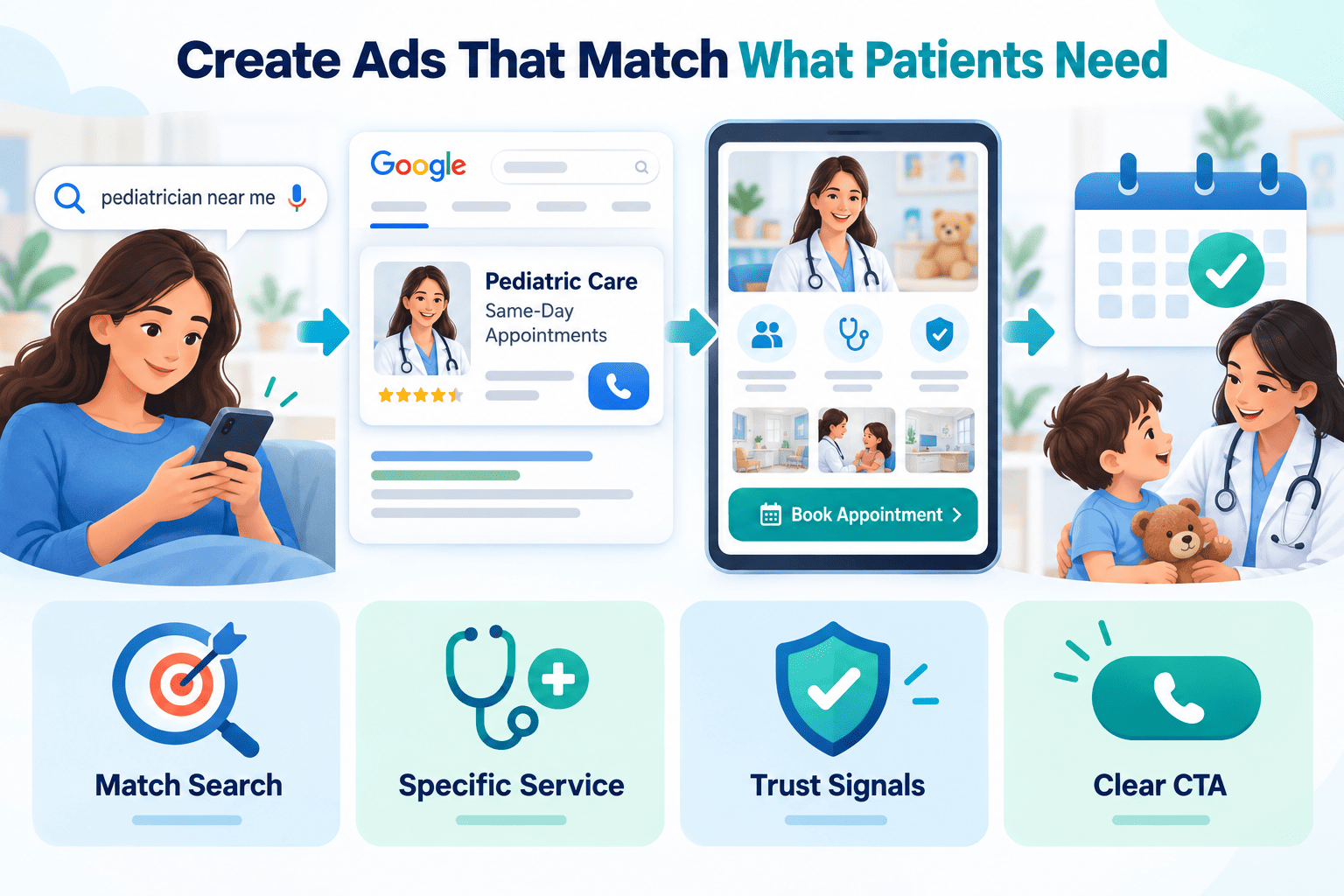
Google’s main Search ad format is the responsive search ad. Advertisers can currently provide up to 15 headlines and four descriptions and Google can test different combinations to determine which ones are more relevant for different searches.
That flexibility is useful for medical practices because one ad can address several genuine reasons a patient might choose the clinic without stuffing every message into a single headline.
Send Every Click to the Right Landing Page
Paying for the right click is only half the job.
A patient searching for a specific service should ideally arrive on a page about that service not a generic homepage that forces them to search again.
A strong medical landing page answers the questions a prospective patient is likely to have. It should clearly explain the service who provides it where the practice is located how appointments work and how the patient can contact the clinic.
Trust is especially important in healthcare. Relevant professional credentials clear practice information accurate service descriptions and transparent contact details can help visitors determine whether the provider fits their needs.
Mobile usability also matters. A patient searching from a phone should be able to read the page find the clinic call or request an appointment without struggling through small text or complicated forms.
Track Appointments Not Just Clicks
A campaign receiving hundreds of clicks is not necessarily successful.
Doctors need to know what happens after someone reaches the website. Useful conversion actions may include appointment requests qualified contact forms and phone calls generated from advertising.
Google Ads provides conversion tracking to connect ad interactions with meaningful actions. Google describes conversions as valuable actions such as leads or phone calls and says conversion data can help advertisers identify the ads and keywords contributing to business results.
For medical practices conversion setup should also be approached carefully because healthcare information can be sensitive. Tracking tools forms and advertising platforms should be configured with appropriate privacy practices and the practice should comply with applicable laws and platform policies.
Instead of asking only “How many clicks did we get?” the better question is “Which searches are producing suitable patient inquiries at a reasonable cost?”
Understand Google’s Healthcare Advertising Rules
Doctors should not assume that every medical service can be advertised in the same way.
Google maintains specific Healthcare and Medicines advertising policies. Some healthcare-related content is restricted some can only be advertised in certain locations and certain categories require advertiser certification.
Rules can become more specific for services involving prescription drugs telemedicine addiction treatment pharmaceutical products and other regulated areas. For example Google restricts advertising related to online prescribing dispensing and selling prescription drugs and requires certification for eligible advertisers in supported locations.
Policies can also change. Doctors or agencies managing healthcare campaigns should check the current rules for their service and target country instead of relying on an old campaign setup or marketing guide.
Local medical advertising laws and professional regulations may create additional requirements beyond Google’s own rules.
Where SEO Fits Into the Strategy
Google Ads disappears when the advertising stops. Organic rankings work differently.
SEO aims to make relevant pages easier for search engines and patients to find naturally. For doctors that may involve well-developed service pages location pages accurate practice information useful medical content internal linking local search optimization and a technically sound website.
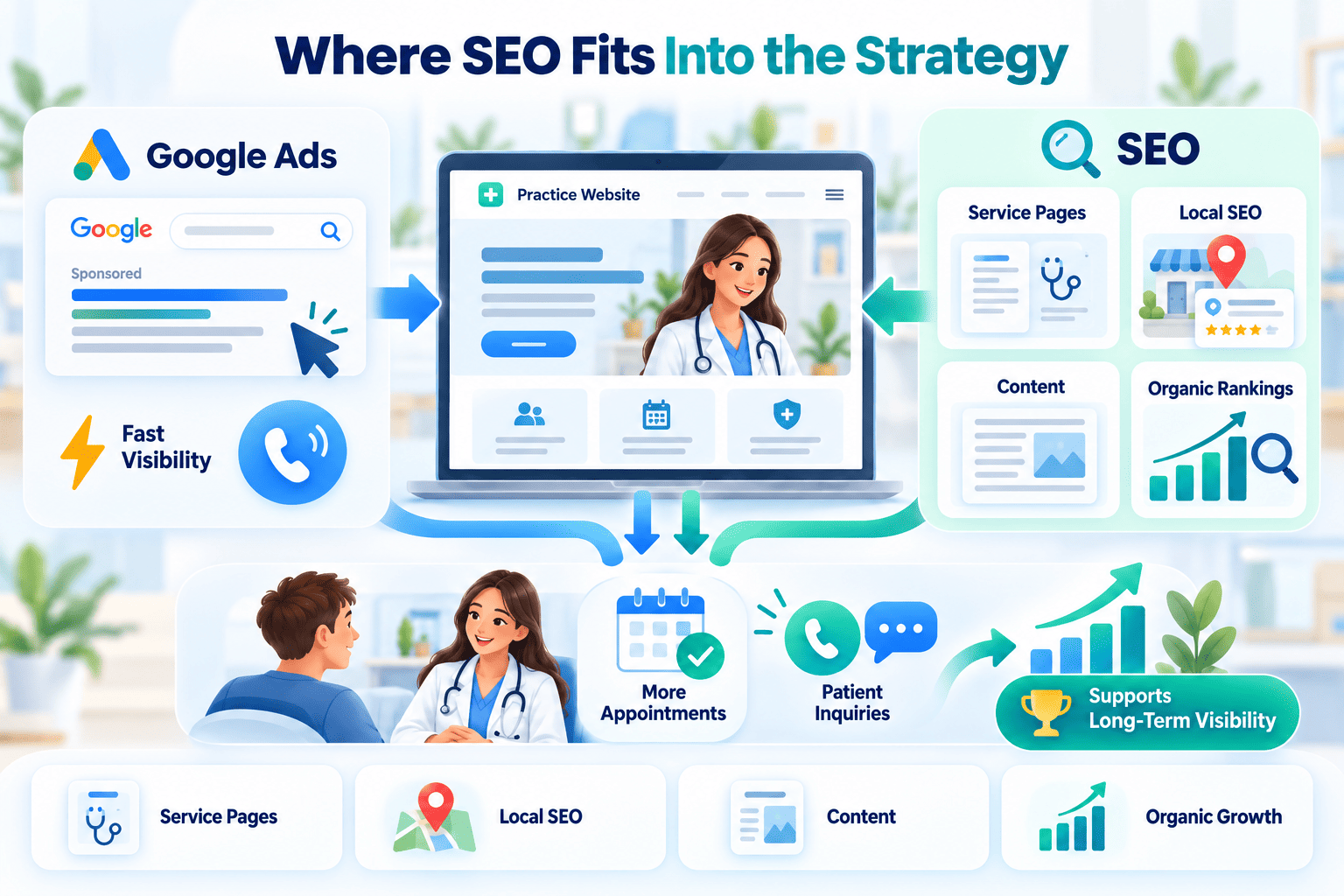
The strongest google ads for doctors seo outline therefore gives paid and organic search different jobs.
Paid search can focus heavily on commercial and appointment-driven terms. SEO can target those same core services while also building visibility for symptoms treatment questions procedure information recovery questions and other topics patients research.
Advertising data may also uncover useful SEO opportunities. If certain search terms repeatedly generate good patient inquiries through Google Ads those terms can help a practice understand what prospective patients value and which services deserve stronger organic pages.
SEO can work in the opposite direction too. Search Console data and high-performing organic pages can reveal topics and language that may improve paid campaigns.
Build Campaigns Around Services Instead of One Large Account
One common problem in medical PPC is putting too many services into the same campaign or ad group.
A multi-specialty practice may treat dermatology cardiology pediatrics and orthopedics but those patients are looking for completely different things. The keywords ad messages landing pages budgets and conversion values may all differ.
Separating campaigns logically makes performance easier to understand.
If orthopedic searches are generating strong appointment demand while another service is consuming budget without qualified inquiries the practice can make a meaningful decision. That becomes harder when unrelated searches are mixed together.
The same logic applies to SEO. Each important service should have enough dedicated information to satisfy someone specifically looking for that type of care.
Avoid Measuring Success by Rankings or Traffic Alone
SEO rankings and ad clicks are useful indicators but neither pays the clinic’s bills.
A medical marketing strategy should ultimately connect search visibility to patient acquisition.
That means looking beyond impressions clicks traffic and average ranking positions. Practices should pay attention to qualified inquiries appointment requests cost per lead conversion rate and where appropriate whether those inquiries are becoming actual patients.
Quality matters as much as volume. Twenty relevant inquiries for a service the practice provides may be more valuable than hundreds of visitors who leave without contacting anyone.
Google Ads and SEO become much easier to evaluate when the practice defines what a valuable patient action looks like before launching campaigns.
FAQs
Are Google Ads effective for doctors?
Yes. They can reach patients who are actively searching for a doctor specialist treatment or nearby medical service.
How much should a doctor spend on Google Ads?
There is no standard budget. Appropriate spending depends on specialty location competition click costs conversion rates and patient-acquisition goals.
Is SEO or Google Ads better for doctors?
They serve different purposes. Google Ads can generate paid visibility quickly while SEO is designed to build organic search visibility over time.
What keywords should doctors target with Google Ads?
Focus on terms closely connected to the practice’s specialties services treatments patient intent and geographic service area.
Does Google restrict healthcare advertising?
Yes. Google restricts some healthcare categories and requires certification in certain cases so advertisers should check the current policies before launching campaigns.
Final Thoughts
A useful google ads for doctors seo outline is not about choosing between paid advertising and organic search. It is about making each channel support the way real patients find and evaluate healthcare providers.
Google Ads can put a practice in front of people with immediate needs while SEO can build visibility across a broader range of searches and continue attracting prospective patients without paying for every click.
The strongest strategy starts with patient intent separates services clearly uses relevant landing pages measures meaningful conversions and follows current healthcare advertising rules. When those basics are in place doctors can make marketing decisions based on patient inquiries and appointments instead of chasing traffic for its own sake.
Sources: