
Artificial intelligence is changing how people search for information discover businesses and make buying decisions. From AI-generated answers to automated keyword research many SEO tasks that once took hours can now be completed in minutes. This shift has raised an important question for marketers website owners and content writers: will AI replace SEO or will it change how SEO works?
The short answer is no AI is unlikely to replace SEO completely. However it is changing how search engines understand content how users find information and how businesses compete for online visibility. Traditional SEO methods alone may no longer be enough to achieve strong results.
Businesses now need to understand AI-powered search create genuinely useful content and make their websites easy for both search engines and people to understand. Let’s explore what AI means for SEO and how professionals can prepare for the changes ahead.
Will AI Replace SEO Completely?
AI will not eliminate SEO but it will change many parts of the process. Search engines still need to discover web pages understand their content assess relevance and connect users with useful information. These tasks remain central to search engine optimization.
According to Google Search Central traditional SEO best practices continue to apply to AI-powered search experiences including AI Overviews and AI Mode. Websites still need useful content sound technical foundations and accessible pages to become eligible for visibility in these features.
What is changing is how people receive answers. Instead of clicking through several websites to compare information users may get a summarized answer directly in search results or an AI assistant.
This creates new challenges for website owners. Some searches may produce fewer clicks while other searches may help users discover relevant businesses and resources through AI-generated responses.
SEO professionals must therefore focus on more than rankings alone. They need to consider visibility website traffic brand recognition and conversions across different search experiences.
How AI Is Changing the SEO Industry
AI is already influencing several parts of SEO. Understanding these changes helps businesses decide which tasks to automate and where human expertise remains important.
1. Automated Keyword Research
Keyword research helps marketers understand what people search for and why they search for it. AI tools can analyze large keyword lists identify related topics group similar queries and suggest content ideas.
For example a company selling project management software can use AI to identify searches related to team collaboration task tracking workflow automation and project planning.
However keyword suggestions alone do not guarantee a successful strategy. SEO professionals still need to assess search intent competition business goals and the value a topic offers to potential customers.
2. Faster Content Creation
AI can help writers create outlines organize research develop initial drafts and improve readability. It can also identify missing topics and suggest ways to answer common customer questions.
These capabilities can make content production faster particularly for businesses managing large websites.
However publishing large amounts of generic AI content is not a reliable SEO strategy. Google’s guidance emphasizes accuracy originality relevance and value for readers. Content created at scale without meaningful value may violate its spam policies.
Human editors remain important for checking facts adding useful examples improving the writing and ensuring that an article meets its intended purpose.
3. Smarter Technical SEO
Technical SEO involves making websites easier for search engines to crawl index and understand. AI-powered tools can help identify broken links detect unusual traffic patterns review page performance and highlight possible technical problems.
These tools can save time by directing attention toward issues that need investigation.
Still AI recommendations require careful review. A tool may identify a possible problem without understanding the website’s complete structure or business requirements. SEO professionals must confirm the issue and choose the right solution.
4. AI-Powered Search Results
AI Overviews and other AI-powered search experiences are changing how users discover information online. Search engines can combine information from multiple sources to provide direct answers to complex questions.
This means a website may gain visibility through a cited link in an AI-generated answer even when the user does not interact with a traditional search result in the usual way.
For businesses this makes helpful content and clear information more important. However appearing in an AI-generated answer is not guaranteed even when a website follows SEO best practices.
Which SEO Tasks Can AI Replace?
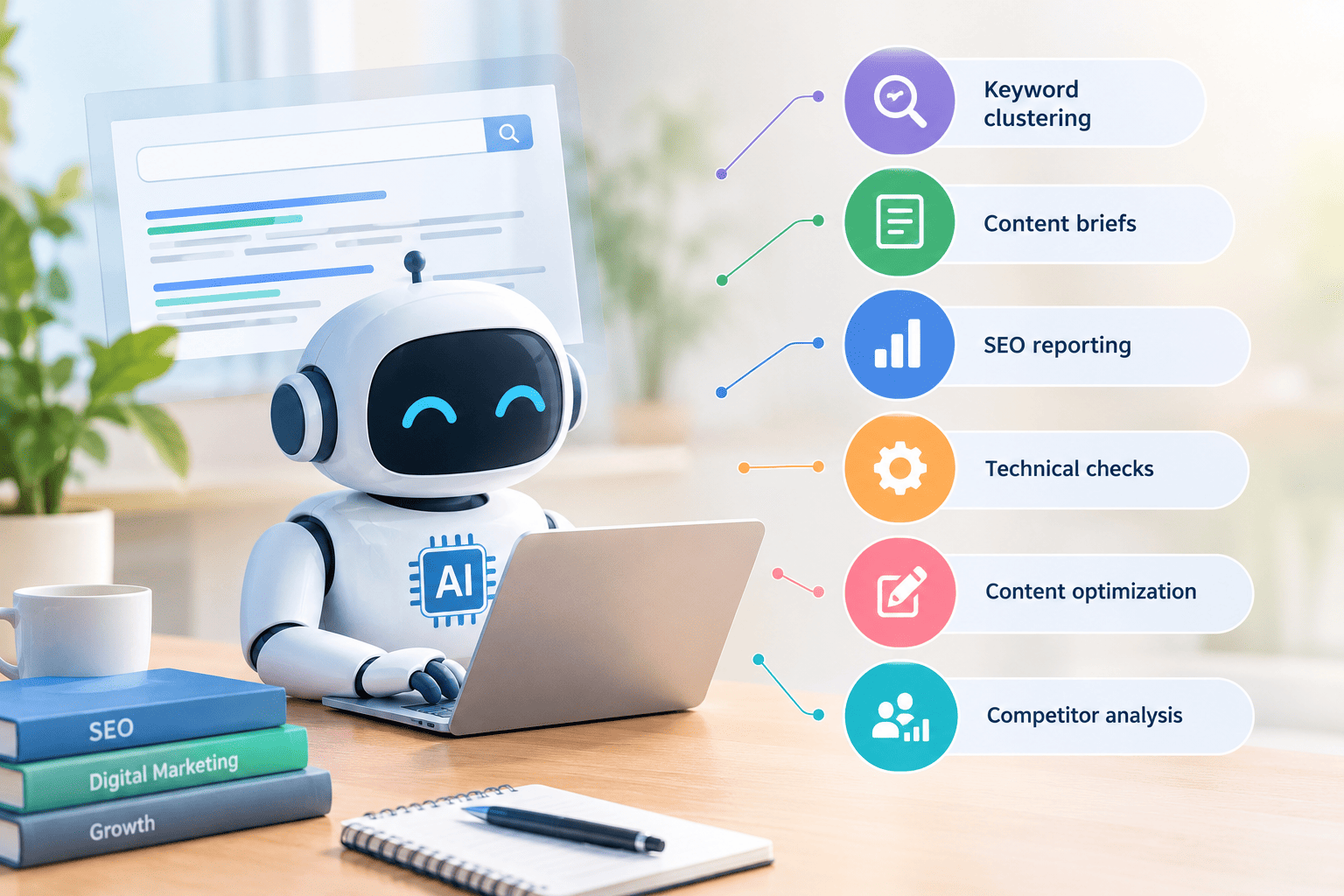
AI is most effective at tasks that are repetitive data-heavy or easy to standardize. It can reduce manual work but that does not mean it can manage an entire SEO campaign independently.
Here are some tasks AI can help automate:
- Keyword clustering: Grouping related keywords into relevant topics.
- Content briefs: Preparing initial outlines and suggesting important subtopics.
- SEO reporting: Summarizing performance data and highlighting changes.
- Technical checks: Identifying potential broken links crawl issues and page errors.
- Content optimization: Suggesting title improvements clearer headings and relevant internal links.
- Competitor analysis: Organizing publicly available information about competing pages.
These tasks can become faster with AI assistance allowing SEO professionals to spend more time on strategy and decision-making.
However automation has limits. AI-generated reports may overlook context keyword suggestions may not reflect business priorities and automated content recommendations may produce similar results to those already available online.
The best approach is to use AI to support routine work while keeping people responsible for reviewing findings and deciding what to do next.
Why Human SEO Experts Will Still Matter
If AI can complete so many SEO tasks why would businesses continue hiring SEO professionals? The answer is that successful SEO requires more than producing content or collecting data.
Strategic Thinking and Business Understanding
SEO experts connect search performance with wider business goals. They determine which topics attract potential customers which pages support sales and which improvements deserve priority.
An AI tool might suggest targeting a high-volume keyword. An experienced SEO professional will also consider whether that keyword attracts the right audience and whether the business can realistically compete for it.
This type of judgment helps companies avoid spending time and money on traffic that does not lead to meaningful results.
Experience and Original Insights
Search results already contain large amounts of general information. Publishing another article that repeats familiar advice may offer little reason for users to choose one website over another.
Human experts can contribute firsthand experience customer feedback original research and practical lessons that make content more useful.
Google’s guide to optimizing for generative AI features specifically highlights unique valuable content that goes beyond information easily reproduced by AI.
For example a marketing agency can strengthen an article by sharing lessons from real campaigns explaining why a strategy failed or presenting original performance data. Such insights provide more value than a basic AI-generated summary.
Trust Accuracy and Accountability
AI can produce confident answers that contain errors outdated details or unsupported claims. SEO professionals must verify information especially when content covers finance healthcare legal matters or other topics where mistakes can cause harm.
They also need to understand brand guidelines customer expectations and the wider purpose of a website.
Human oversight helps ensure that content is accurate relevant and consistent with the business’s standards.
How to Prepare Your SEO Strategy for AI
Businesses do not need to abandon traditional SEO to adapt to AI. Instead they should strengthen the fundamentals while adjusting their approach to changing search behavior.
1. Create Content That Offers Real Value
Write for people who need answers solutions or practical guidance. Avoid publishing articles that simply repeat information available on dozens of other websites.
Include relevant examples expert explanations original observations and clear answers to the questions your audience asks. Every page should have a clear purpose and offer something useful.
2. Continue Following SEO Fundamentals
Technical SEO still matters. Make sure search engines can crawl important pages internal links connect related content and website pages load properly across devices.
Use descriptive page titles clear headings relevant internal links and accurate structured data where appropriate.
Google has confirmed that there is no separate technical requirement or special markup needed to appear in AI Overviews or AI Mode. Existing SEO best practices remain the foundation.
3. Understand Search Intent
Do not focus only on what people type into search engines. Consider what they actually want to achieve.

Someone searching for the best accounting software may want a comparison of prices and features. Someone searching for how to calculate business taxes may need a step-by-step explanation.
Matching content to these needs makes it more useful and can improve the chances of attracting relevant visitors.
4. Use AI Without Losing Your Brand’s Voice
AI can help with research outlines editing and brainstorming. However every published piece should reflect the business’s knowledge audience and communication style.
Review AI-generated content carefully. Check facts remove repetition improve weak explanations and add original insights before publishing.
The goal is not to produce the highest possible number of articles. It is to create content that deserves the reader’s attention.
5. Measure More Than Rankings
Search visibility is still important but rankings alone do not tell the whole story.
Monitor organic traffic conversions qualified leads engagement and the performance of important landing pages. Where available use relevant reporting tools to understand how people discover your content through AI-powered search features.
This broader view helps businesses understand whether their SEO strategy is supporting real outcomes.
Will AI Replace SEO Jobs?
AI will likely change SEO job responsibilities but it does not mean every SEO professional will lose their job.
Some repetitive tasks may require less manual effort. As a result businesses may expect SEO professionals to manage larger datasets work more efficiently and use automation effectively.
At the same time demand may continue for people who understand search strategy technical SEO content quality analytics and business growth.
SEO professionals can prepare by developing skills in AI-assisted research data analysis technical problem-solving content strategy and conversion optimization.
Content writers can also strengthen their position by learning how to conduct reliable research interview subject experts create original insights and edit AI-assisted drafts to a high standard.
The most valuable professionals will be those who combine the speed of AI with sound judgment and practical experience. Rather than competing with AI at every task they can use it to improve the quality and efficiency of their work.
FAQs
1. Will AI replace SEO in the future?
No AI is more likely to change SEO than eliminate it. Websites will still need useful content technical optimization and strategies that connect them with relevant audiences.
2. Can AI do SEO better than humans?
AI can handle many repetitive SEO tasks quickly but humans remain important for strategy judgment original insights and business decisions.
3. Will AI replace SEO content writers?
AI may automate parts of content production but writers who provide original research expert insights and strong editing skills can continue to offer value.
4. Is SEO still worth learning in 2026?
Yes. SEO remains useful for improving search visibility and attracting relevant visitors especially when combined with an understanding of AI-powered search.
5. How can businesses use AI for SEO?
Businesses can use AI for keyword research content planning technical checks and reporting while relying on human review to ensure accuracy and strategic value.
Final Thoughts
So will AI replace SEO? The evidence points toward a transformation rather than a complete replacement. AI is making research content production and technical analysis more efficient but it has not removed the need for search optimization.
Businesses still need to understand their audiences publish useful information maintain accessible websites and build trust. SEO professionals must adapt by learning new tools improving their analytical skills and focusing on work that requires experience and sound judgment.
The strongest approach is to combine AI’s efficiency with human expertise. Use AI to reduce repetitive work but do not let automation replace original thinking or meaningful content.
SEO will continue to evolve as search technology advances. Businesses that stay flexible follow reliable SEO practices and put users first will be better prepared for whatever comes next.